Medical Guardian Review, Our Hands-On Test (2026)

After months of testing Medical Guardian's complete lineup of four medical alert systems, we were genuinely impressed by the company's lightning-fast emergency response times and professional monitoring service. We found their devices to be excellent options for older adults who want functional, reliable, and even discreet monitoring.
The higher monthly costs and additional fees for essential features like fall detection, however, gave us pause. Medical Guardian delivered on their promises of reliability and useful caregiver features, but you'll pay a premium for these benefits compared to other providers.
Pro Tip: To find medical alert systems starting at $20 per month, read our rundown of this year’s best medical alert systems.
Methodology: How we tested Medical Guardian
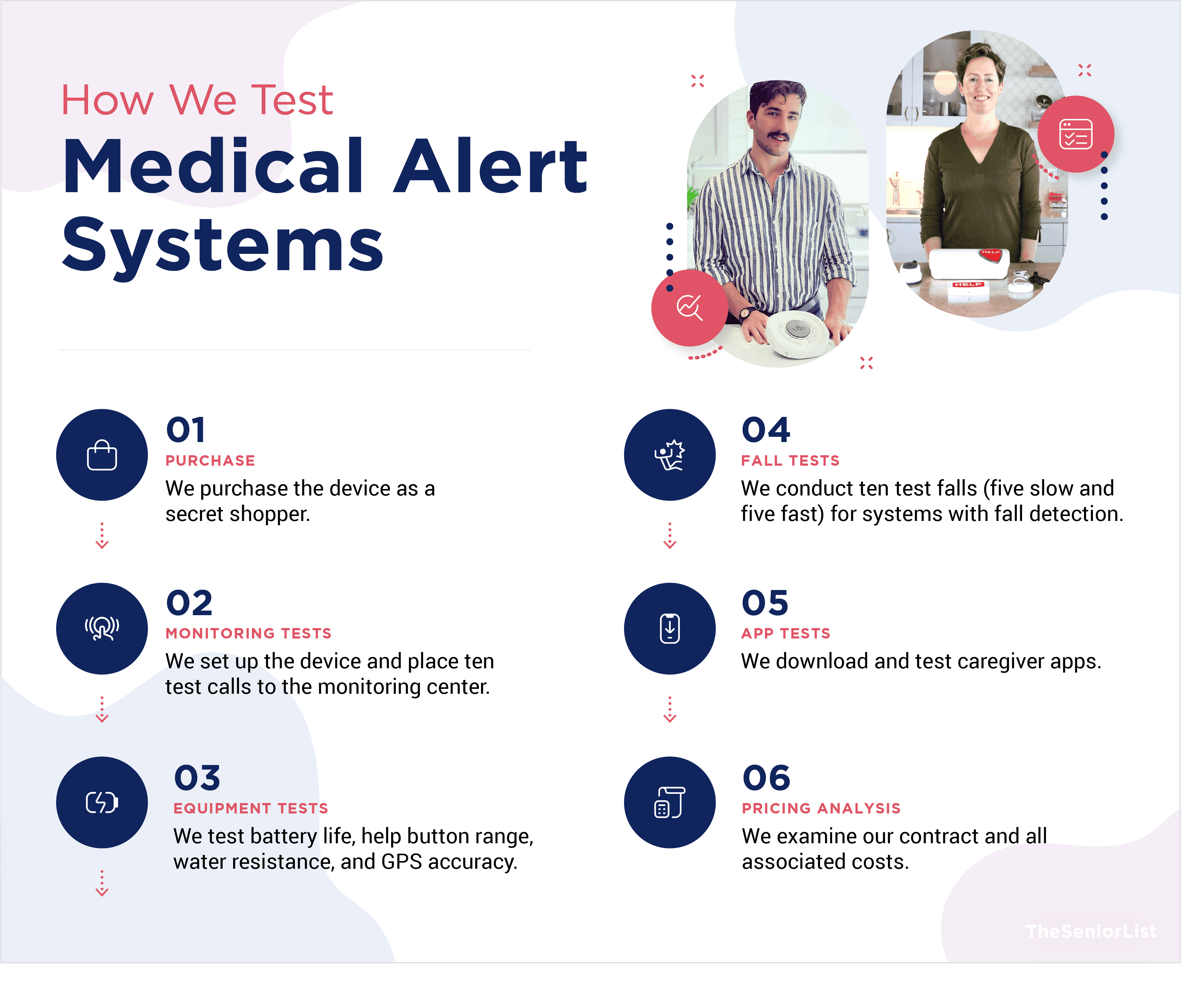
Our medical alert system testing process takes one week per device, during which time we install the system in our homes, test out each of its features, and examine how it compares to similar devices.
Because most providers offer a range of systems — including in-home units, mobile devices, and smartwatches — we evaluate each one with the understanding that, at their core, they all serve the same purpose: quickly connecting users to help in an emergency.
We evaluated each Medical Guardian system based on the following criteria:
Response times: We placed 10 test calls with each Medical Guardian system and calculated the average response time.
Ease of use: Through testing and design analysis, we ensured that each device was easy to use, particularly for those with visual impairments and manual dexterity issues.
Customer care: We conducted extensive interactions with Medical Guardian’s customer care teams and monitoring agents, ensuring they offered adequate support.
Affordable pricing: We examined the costs of our Medical Guardian systems and compared them to similar systems from other companies.
Flexible contracts: We read the fine print of our Medical Guardian service agreement, ensuring there were no unexpected fees or obligations.
Extra features: Apart from conducting test calls, we also tested Medical Guardian’s fall detection, water-resistance, in-home range, GPS, and caregiver connectivity features.
Why Trust Us?
Our team of caregivers, experts, and healthcare professionals conducted over 5,000 hours of in-depth research and testing. As a result, our team recommended the most reliable brands and devices by:
- Testing 50 medical alert devices from 15 brands
- Surveying 1,250 seniors and caregivers on medical alert system usage
- Consulting with nurses, EMTs and caregivers who are experts at caring for older adults
- Publishing dozens of videos that demonstrate our medical alert system testing
- Evaluating verified customer reviews of medical alert companies from the Better Business Bureau
- Continuing to monitor developments in the world of medical alert systems and revising our findings accordingly
Key Takeaways
- Medical Guardian offers reliable emergency response with flexible device options, but their costs tend to be higher than those of many competitors.
- Like many medical alert system providers, Medical Guardian charges an additional $10 a month for fall detection.
- The strength of Medical Guardian lies in its large in-home ranges, fast response times, and wide variety of systems and accessories.
Medical Guardian Pros and Cons
Pros
- Lightning-fast emergency response times: In our test calls, Medical Guardian's urgent response agents answered in an average of eight seconds. That's faster than any other system we've tested, including Bay Alarm Medical.
- Equipment for all needs: Medical Guardian boasts four medical alert systems—two in-home systems and two mobile systems, one of which is a smartwatch.
- Wide detection range: Medical Guardian's MGHome Cellular system has one of the largest detection ranges on the market. We could be 1,400 feet away from the base station and still communicate during an emergency. That is more than adequate for most homes or apartments.
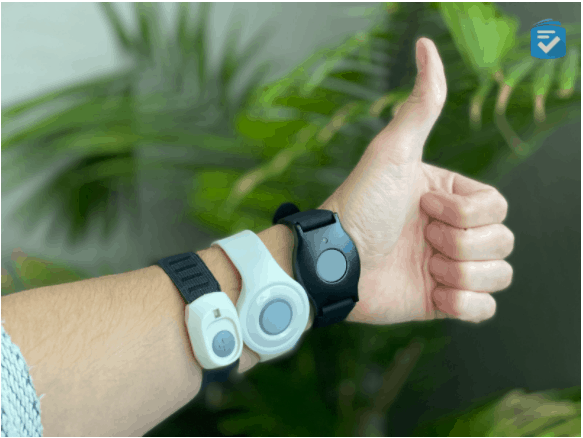
- Multiple ways to wear: Medical Guardian offers necklace and wristband options for its in-home systems, and necklace, wristband, and belt clip attachments for the on-the-go system.
- Power outage backup: Our home systems had 32-hour backup batteries, which helped our medical alert system stay on, even during a power outage one summer evening.
Cons
- Higher monthly costs: Medical Guardian costs are a bit higher than other systems on the market. On-the-go systems start at $38.95 a month, and at-home systems start at $27.95 a month, and that’s only if you pay upfront for a year. Compare that to MobileHelp prices, which start at $25.95 per month for a home cellular system.
- Equipment costs: Medical Guardian charges a one-time equipment fee, which starts at $149.95.
- Fall detection not included: Like most medical alert systems, fall detection is an additional $10 a month. However, with the in-home systems, you’ll need to wear the fall-detection pendant.
New to the ins and outs of medical alert systems? Read our guide to medical alert devices to learn more.
Medical Guardian Systems Overview
| System | Connection | Monthly Subscription | Quarterly Subscription | Annual Subscription | Equipment |
|---|---|---|---|---|---|
| MGHome Landline | Landline | $31.95/month | $89.85 ($29.95/month) | $335.40 ($27.95/month) | $149.95 |
| MGHome Cellular | Cellular | $38.95/month | $110.85 ($36.95/month) | $419.40 ($34.95/month) | $149.95 |
| Guardian Flex | Cellular
WiFi GPS |
$44.95/month | $128.85 ($42.95/month) | $479.40 ($39.95/month) | $149.95 |
| MGMove | Cellular
WiFi GPS |
$42.95/month | $140.85 ($46.95/month) | $539.40 ($44.95/month) | $199.95 |
Most Medical Guardian systems ship within two to three business days, and standard delivery usually arrives within a week. Setup is easy; simply activate the device and place it on the charging cradle for a few minutes.
Every system is compatible with the MyMedicalGuardian caregiver portal, and all are compatible with fall detection. According to the CDC, over 14 million older adults report falling each year, and about 37 percent of those falls result in injuries requiring medical treatment.1

MGHome Landline
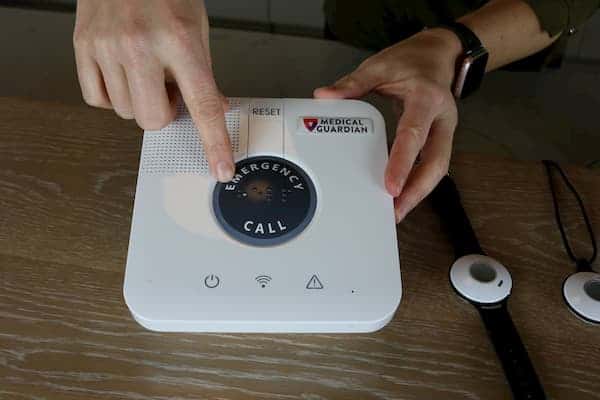
Starting at $31.95 per month with the monthly package ($27.95 per month if you pay annually), the MGHome Landline is Medical Guardian's most affordable and basic medical alert system. It's also the company's only non-cellular system, meaning it required us to have a landline.
For the one in four Americans who rely on landlines2 (many of whom are older adults), the MGHome Landline could be an affordable way to get in-home medical alerts.
We could use our pendant up to 1,300 feet away from the base station. That's more than enough for our one-bedroom apartment, but it may not work for very large homes.
During a power outage, our system stayed on due to its backup battery. Falls and similar emergencies are more likely to happen in dark environments, so at least if the lights go out, you can still have a functioning medical alert system on hand.
MGHome Cellular
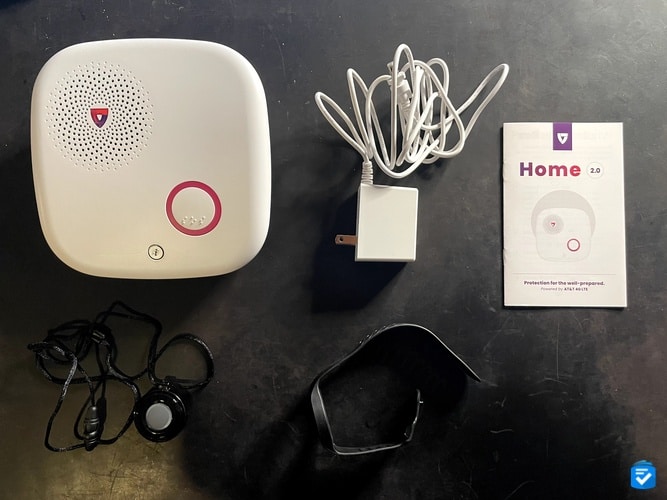
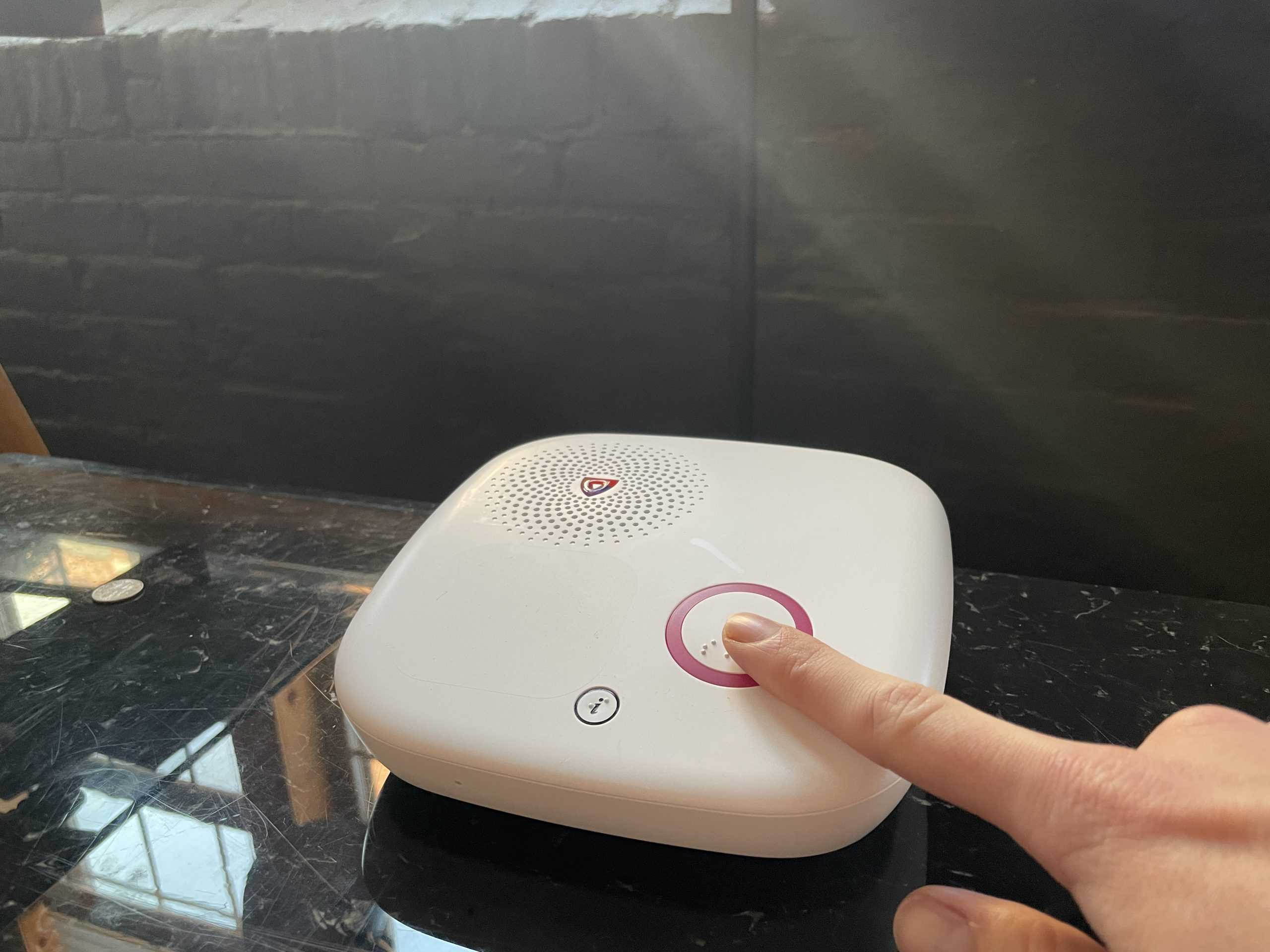
The MGHome Cellular functions exactly like the MGHome Landline. Instead of using an existing landline, however, it runs on 4G LTE, hence the higher cost ($34.95 per month if you pay annually).
In our tests, the speakerphone on the system was especially loud, allowing us to communicate with response agents from multiple rooms away from the system's base unit. Plus, this version has an even wider range: 1,400 feet away from the base station compared to the MGHome Landline's 1,300 feet.
Guardian Flex
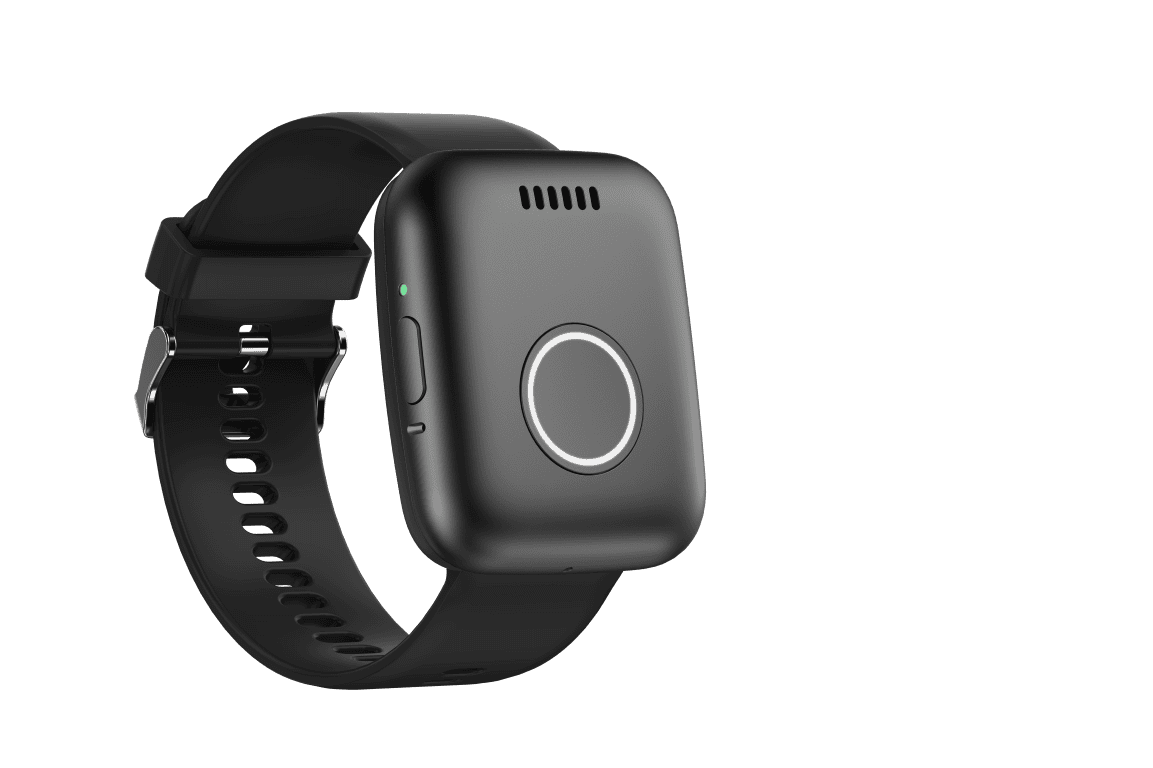
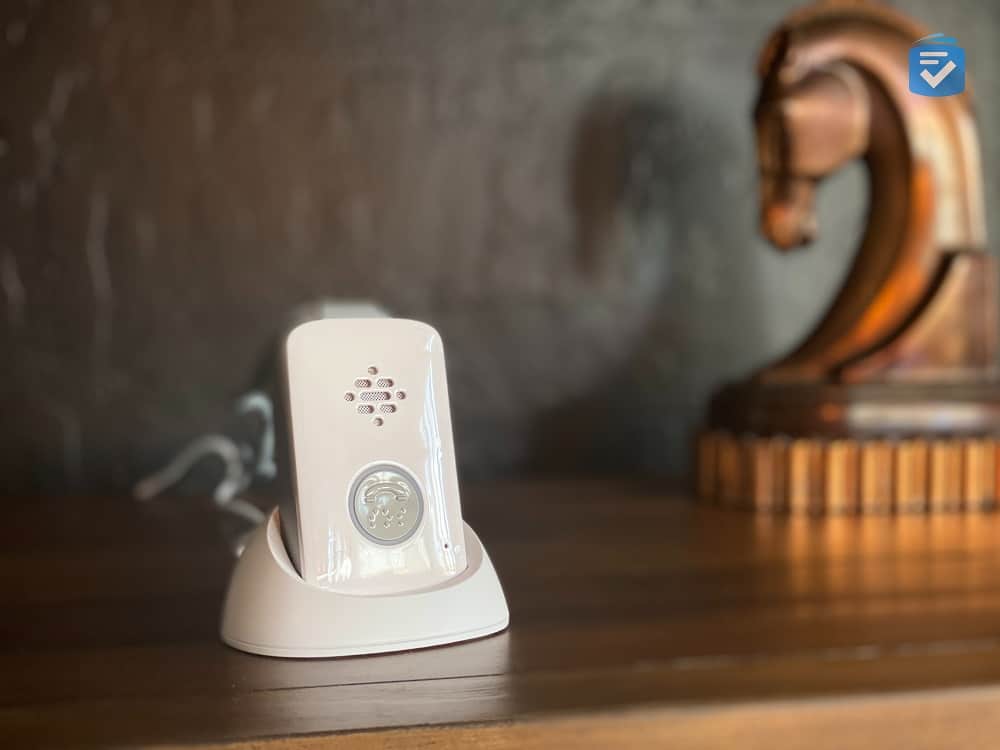
The first portable system we tested from Medical Guardian was the Guardian Flex. We had multiple options on how we could wear the pendant, but for this test, we wore ours on lanyards.
The first thing we noticed about the Guardian Flex was its lightweight, low profile. The Guardian Flex is Medical Guardian’s lightest device. We love how it wasn’t bulky and how easily we could switch from necklace to wristband to belt attachment as needed.
The Guardian Flex, which runs on Verizon’s network, is Medical Guardian’s newest addition to its lineup, and the technology proves it! The Guardian Flex offers helpful, premium features like:
- Advanced Fall Detection ($10/month)
- Two-Way Talk
- Find My Device
- Access to the Care Circle and App
The Guardian Flex lasted five days without needing a charge — great for seniors who may forget to charge their device from time to time.
Like all of the portable systems, it's water-resistant and still worked even while bathing and showering. Water-resistance is extremely important, especially since bathrooms are one of the most common places for falls to occur.
MGMove
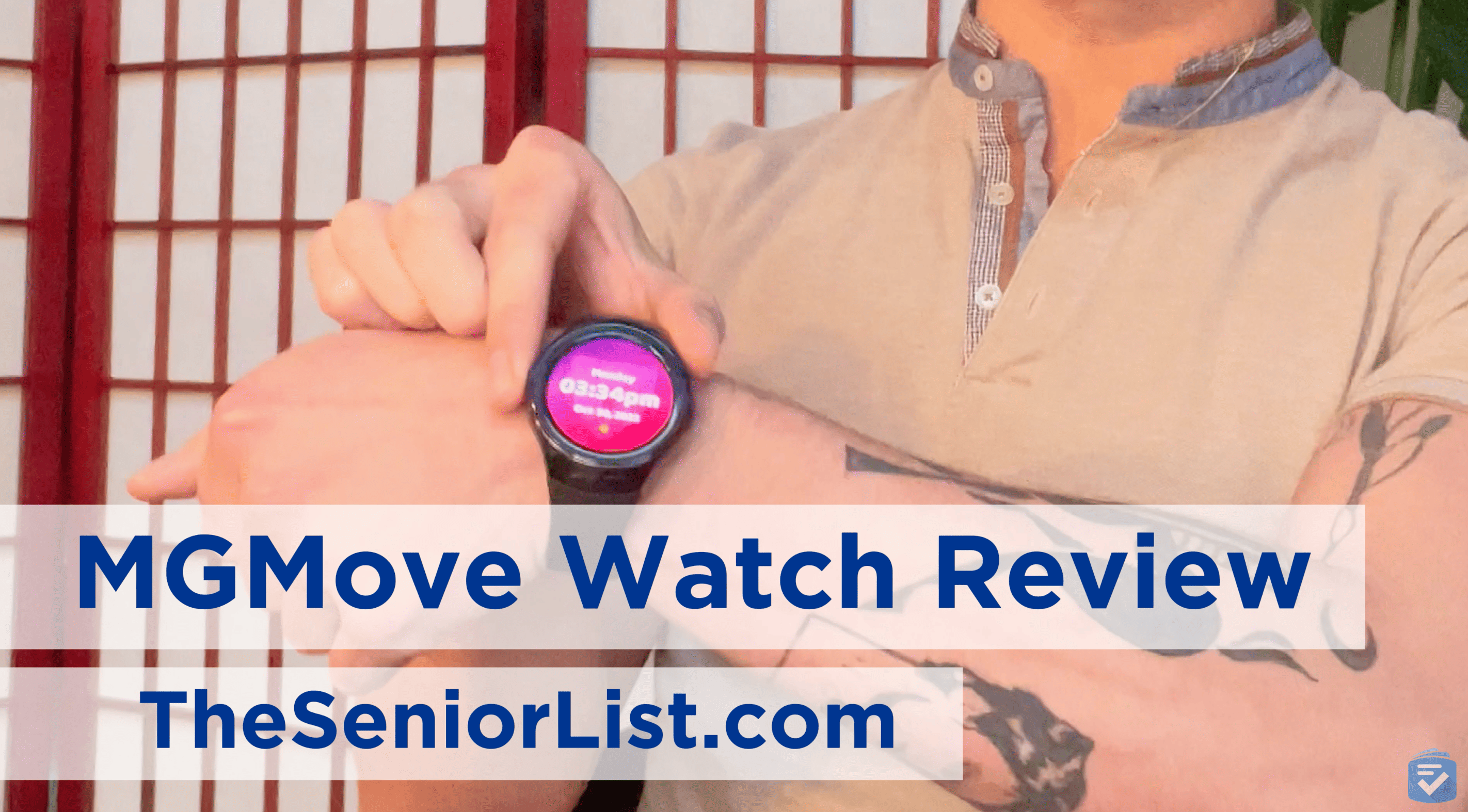
The last system from Medical Guardian is the MGMove, the company’s only smartwatch. In addition to all the features of the other pendants, the MGMove allowed us to:
- Count our steps
- Send voice texts to loved ones
- Get medication reminders
- Check the weather
Those features placed it somewhere between an Apple Watch and a medical alert system.
However, the advanced features come with drawbacks. Not only did the MGMove have the shortest battery life of any of the devices, but it also weighed the most, at 0.13 pounds. It also cost the most, $49.95 per month with the flexible, month-to-month option (or $44.95 per month when paid annually).
Despite its weight (and price), the MGMove is a discreet system for seniors who may not want everyone to know they’re wearing a medical alert device. It looks like a standard smartwatch, and even has a functional touchscreen and several basic features that one can find with any other smartwatch.
Head to our MGMove video review for all the details, or read our MGMove review.
MyMedicalGuardian App and Portal
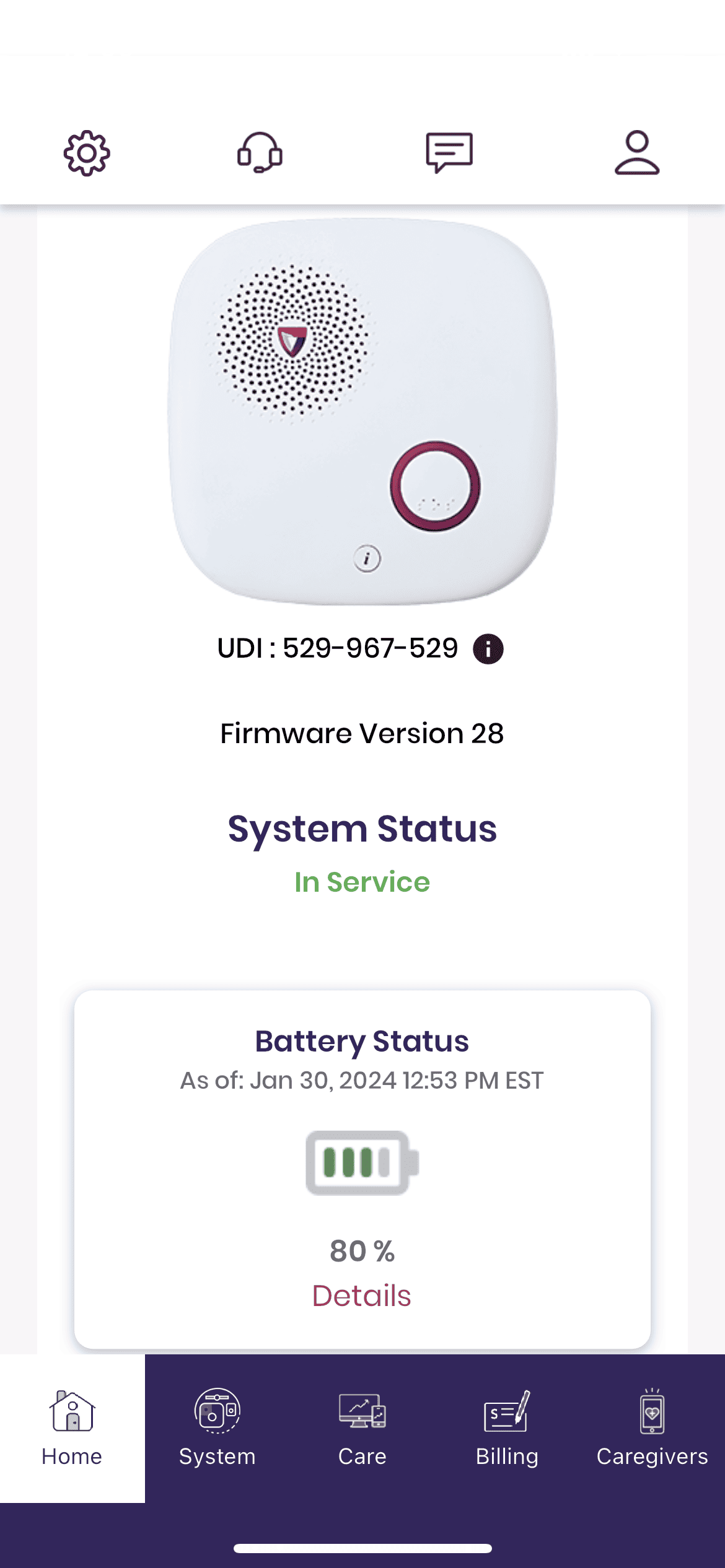
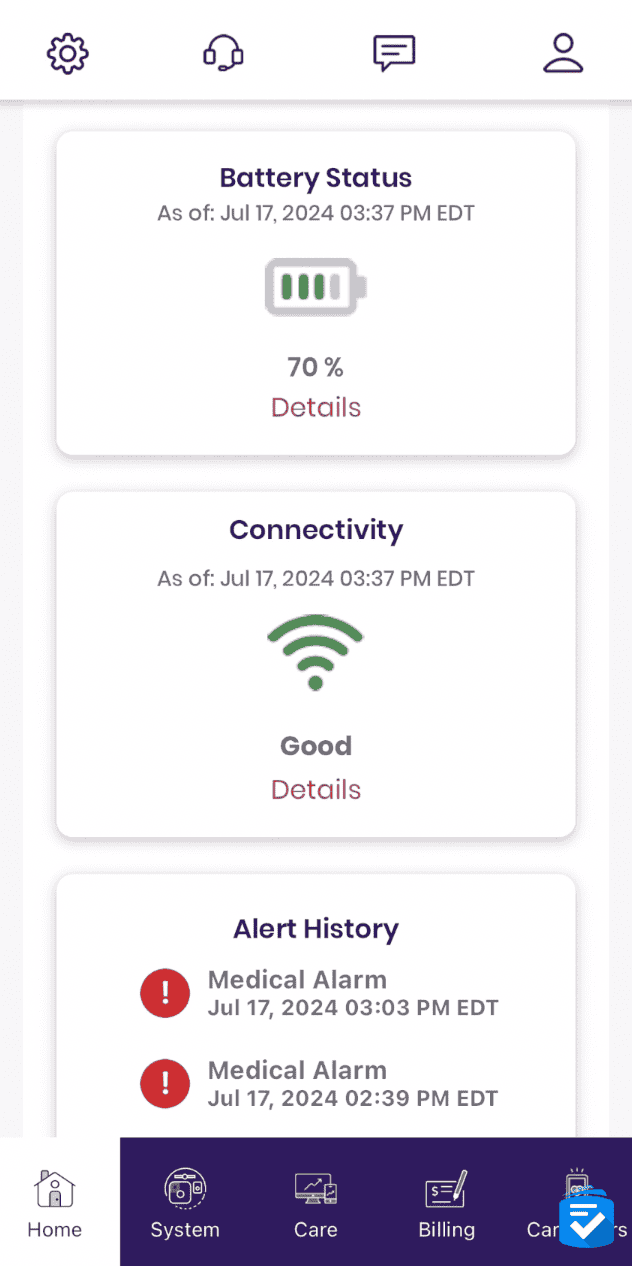
Available on both smartphones and computers, the MyMedicalGuardian app allowed us to keep track of our monthly billing and emergency contacts. It also allowed us to track our systems' battery lives and signal strengths.
With those metrics, our caregivers could ensure that our devices were working from afar. For example, using this platform, we added contacts who would receive notifications whenever we placed emergency calls with any of the systems.
During our testing period, we found the app interface intuitive and responsive. The real-time location tracking was particularly impressive. Family members could see not just that we were safe, but also exactly where we were located.
The medication reminder feature sent gentle notifications that weren't intrusive, and the ability to set custom messages for different contacts added a personal touch to emergency communications.
It's important to note, however, that the MyMedicalGuardian app has relatively poor reviews on the App Store and Google Play Store. Complaints vary widely, but many users report errors when adding new caregivers and inaccurate location data. That said, we didn't encounter either of these issues during our tests.
Medical Guardian Add-Ons and Accessories
Most Medical Guardian systems also have multiple paid accessories and add-on services that you can put in your order at checkout. While these devices can offer additional value and security, the costs can add up quickly:
MG Protection Plan
This protection plan offers extended warranty and coverage (between one and two years) for Medical Guardian's devices and help buttons.
OnGuard Alerts
For $2.99 per month, users can have automatic text and email alerts sent to trusted contacts (your “Support Circle”) in the Medical Guardian mobile app.
Elite 911
Medical Guardian's Elite 911 is a portable device that connects you to 911 with the push of a button. It works on a cellular network and features a two-way speaker. The device and service cost $9.99 per month.
Lockbox
A lockbox ensures that emergency responders won't have to break down the door just to reach you. Instead, they'll be given the code to unlock the lockbox and retrieve a key to enter. Medical Guardian's lockbox costs $2.99 per month.
Pendant Combo
If you'd like additional pendants that can be worn around the neck or wrist, the black or white pendant combos are available for $2.99 per month.
Wireless Wall Button
Medical Guardian's wireless wall button can be placed within 500 feet of your base unit and is ideal in high-risk areas, like bathrooms or stairwells. Each wireless wall button costs $2.99 per month.
Voice-Activated Wall Button
Like the wireless wall button, Medical Guardian's voice-activated wall buttons need to be placed within 500 feet of the base unit to function. You just have to say “help me, help me,” and the wall button will automatically contact the emergency monitoring center. Each voice-activated wall button costs $4.99 per month.
Fall Detection Pendant
If you choose a system without built-in fall detection, you can purchase the fall detection pendant to wear around your neck. The pendant costs $10 per month. Even if you do choose a system with built-in fall detection, you'll still need to pay the extra $10 for automatic fall detection.
Medical Guardian vs Bay Alarm Medical
| Medical Guardian | Bay Alarm Medical | |
|---|---|---|
| Home: Landline |
MGHome Landline
|
SOS Home Landline
|
| Home: Cellular |
MGHome Cellular
|
SOS Home Cellular
|
| Mobile: Wearable Device |
Guardian Flex
|
SOS Micro
|
| Mobile: Smartwatch |
MGMove
|
SOS Smartwatch
|
| Fall Detection | $10/month | $10/month |
| Response Time | 8 seconds | 16 seconds |
Our Hands-On Experience
Setup and usability: Both systems were remarkably easy to set up. Bay Alarm Medical’s devices took about 10 minutes to fully configure, while Medical Guardian's took about seven minutes on average. We found Medical Guardian’s pendant design slightly more comfortable for extended wear.
Range and reliability: Medical Guardian’s 1,400-foot range gave us slightly more freedom around our test home and neighborhood. During signal-strength tests in the same locations, Medical Guardian systems maintained clearer communication at the edge of their range, while Bay Alarm Medical’s signals occasionally became scratchy at maximum distance.
To read our full comparison of the two providers, check out our Medical Guardian and Bay Alarm Medical comparison. To learn more about Bay Alarm, read our Bay Alarm Medical review.
Compare Medical Guardian to Other Brands

Final Thoughts on Medical Guardian
The MGHome Landline is a simple, affordable system that does the basics incredibly well. Its wide range, along with simple setup and caregiver communication functionality, make it a great option for seniors who want an at-home system and can afford it at a slightly higher cost.
We’d recommend Medical Guardian if you want:
- An affordable landline system: Starting at $32.95 per month or less if you pay annually or quarterly, the MGHome Landline is a well-built, reliable system that communicates with professional monitoring via an existing landline connection.
- An all-in-one mobile system: Unlike most mobile medical alert systems, the Guardian Flex had everything in one compact device. Not having to lug around extra help buttons helped make it one of our favorite cellular medical alerts.
- Reliable monitoring: It was apparent in each of our test calls that we were dealing with a team of professionals who had super-fast responses.
- Additional buttons: From additional help buttons to voice-activated medical alerts, Medical Guardian offered a full range of accessories so we could tailor our systems to our specific needs.
- Month-to-month contracts: Medical Guardian offers discounts for annual subscriptions, but the company requires only monthly commitments.
We wouldn’t recommend Medical Guardian if you want:
- Zero monthly fees: Medical Guardian costs a minimum of $32.95 per month (or $39.95 per month for the cellular system) if you don’t want to sign up for a long-term contract. That’s about average for in-home medical alerts, but some medical alerts require no monthly charge. To learn more, read our guide to medical alerts with no monthly fees.
- Fall detection included: Unfortunately, none of the systems’ monthly costs include fall detection, bringing costs up by $10 per month. According to the American Journal of Emergency Medicine, falls can lead not just to a loss of independence, but also serious injury and even death.3 Consequently, we think fall detection should be included in each subscription.
Frequently Asked Questions
-
Is Medical Guardian a good company?
Medical Guardian is a good company that offers, in our experience, durable equipment, quick response times, and easy-to-use devices. With nearly 20 years in business (founded in 2005), it has served hundreds of thousands of customers and is accredited with the Better Business Bureau, where it has an A+ rating and a strong customer satisfaction score compared to competitors in the medical alert space.
-
How much is Medical Guardian per month?
Medical Guardian in-home systems start at $27.95 per month. There are also annual and quarterly offers available, and they will come with slight discounts.
-
Is Medical Guardian better than Life Alert?
Based on our hands-on experience, Medical Guardian offers better response times and equipment at a more affordable price than Life Alert. Check out our comparison of Medical Guardian and Life Alert to learn more.
-
Does Medical Guardian offer spousal monitoring on all traditional devices?
Yes, Medical Guardian offers spousal monitoring on their traditional home systems. Monitoring is free, but you’ll have to purchase a second pendant for an additional $2.99 per month. Spousal monitoring is also available on the following traditional Medical Guardian devices, which are no longer available for new purchase:
- Mobile 2.0
- Home 2.0
- Home Guardian
-
Are all Medical Guardian devices waterproof?
No Medical Guardian devices are waterproof, so you can’t immerse them in water for extended periods. They are, however, water-resistant and safe to take in the shower.